
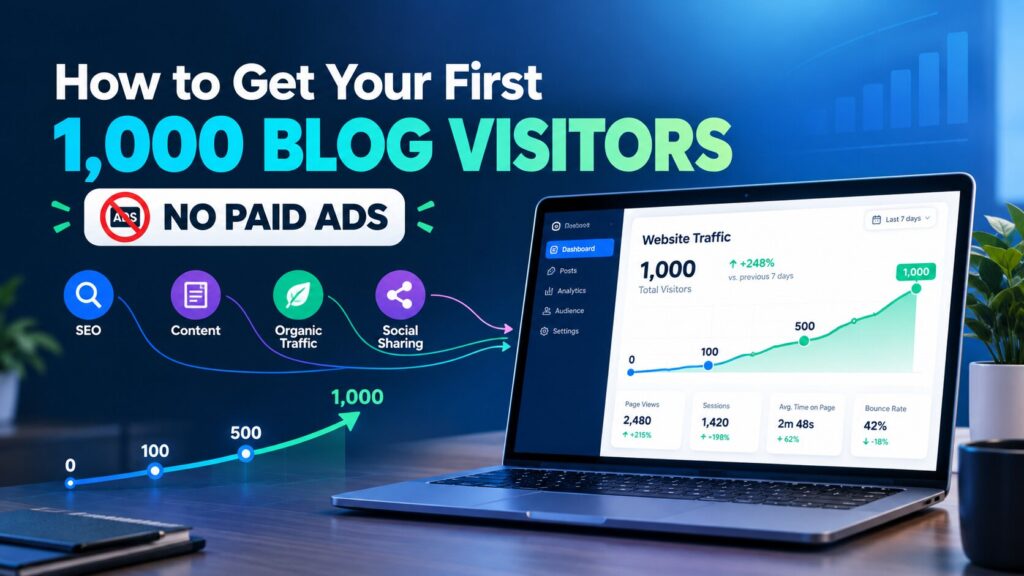
How to Get Your First 1,000 Blog Visitors (No Paid Ads)
Most new blogs fail quietly. Not with a dramatic crash — just a slow silence. A few posts go live, traffic never arrives, and the site gets abandoned somewhere around month three. It happens to the majority of blogs that launch every week, and it almost always happens for the same handful of reasons. All of them are avoidable.
You can get 1,000 monthly visitors in 90 days with five well-optimised posts and the promotion strategies in this guide. It is not a guarantee — it is a documented, repeatable result for bloggers who apply the right channels consistently. The timeline is realistic. The strategies require no budget. What they require is time spent in the right places rather than everywhere at once.
One upfront clarification: “without paid ads” in this guide means organic search, community platforms, guest posts, and email. It does not mean social media virality. Social media traffic converts about 1/10th as well as search traffic does to affiliate blogs. Anyone who already Googled a specific question to get to your post is in buying mode or researching mode. Someone scrolling between other content is not. This guide focuses on channels that compound over time, not channels that require daily posting to stay relevant.
Why Most New Blogs Never Reach 1,000 Visitors
Understanding why most blogs die is more useful than a list of tactics. The same four mistakes kill 99% of all abandoned blogs.
Targeting the wrong keywords
Not for a head term like “best antivirus software”. If you have no authority, no backlinks, no Google Juice.. At 10 years old, those head term keywords are yours. Make target long-tail keywords ‘Best Antivirus for a Windows 11 Laptop under 500 dollars’ — not ‘Best Antivirus’. Long-tail phrases are easier to rank for, have less competition, more intent, and can rank for in 60-90 days if your article is strongly optimised.
However, the Long-tail traffic is much smaller. However, ten long-tail keywords are better than one head term.
Publishing without promotion
In contrast, writing a post and then waiting for Google to find it is a perfectly valid SEO plan. In month 18, not month 1. Every post needs an active promotion in the first week – community responses, a link in your email to subscribers, a guest post proposal that uses that post as support. Google’s time to index for a new site is 2 weeks to 6 weeks without intentional indexing, and active promotion tells Google, “People think this content is worth reading”.
Publishing erratically
HubSpot’s industry-standard stats consistently show that blogs with stable publishing schedules acquire more traffic than those with irregular schedules. Three posts one week, then nothing for a month, performs worse than one post a week for three months. Consistency is not about volume – it is about giving Google and people a predictable signal that the site is active and growing.
Giving up before the compound effects begin
Most visitors come to your blog 60-90 days after your post goes live and is submitted. Bloggers who give up early in the game will not see that traffic. The no-signal-is-failure weeks 3 is just that tag before the algorithm catches up.
Keep your publishing rhythm consistent.
Republish, don’t just publish. Every three months, go back to the best of your posts and add/clarify/restructure them. Google appreciates freshness to improve the best pages.
The Foundation: What to Have in Place Before Promoting Anything
Before any promotion strategy produces results, five things need to be in place. Skip any of them and the promotion effort loses most of its impact.
Five published, fully optimised posts
Not five drafts — five live pages with proper on-page SEO, meta titles, meta descriptions, internal links to each other, and at least one external link to an authoritative source. Five posts give Google enough material to understand what the site covers and begin assigning topical relevance.
Google Search Console set up and all posts submitted:
Open Search Console, go to URL Inspection for each post URL, and click Request Indexing. Without this step, Google discovers new posts on its own crawl schedule — which takes 2 to 6 weeks for a new domain. Request Indexing accelerates this to days in most cases. None of the SEO work in your posts matters until Google has indexed them.
An email opt-in form on every post:
Start building your list from visitor one, not after reaching 1,000. Many new bloggers think they should wait until they have more readers. In practice, an email list can help bring readers back to your site. Therefore, add a form to your site from day one, even if it initially converts at only 1%. Offer something specific, such as a free checklist, comparison cheat sheet, or useful resource list. A focused offer can perform better than a generic “subscribe for updates” message.
A clear About page and affiliate disclosure:
Community platforms such as Reddit and Quora, along with guest post editors, may check these pages before accepting you as a contributor. A clear About page helps visitors understand who runs the site and what the website covers. In addition, an affiliate disclosure tells readers when your content contains affiliate links. Make the disclosure easy to find and keep it visible wherever affiliate recommendations appear.
Strategy 1: Long-Tail SEO — the Only Channel That Compounds Without Daily Effort
Long-tail SEO is the main traffic source for any affiliate blog, and the reason is that it compounds. A good SEO post receives Google traffic in month 3, month 6, month 12, and month 24 without any further effort on that page. No other channel in this guide has that property.
The keyword research:
Use the Google Keyword Planner for volume ranges (free with any Google Ads account; no spend required).
Also Asked for question variations around your seed topic. For example, Google’s own autocomplete- type “best antivirus for” and hit Tab to see what search terms Google recommends. All suggestions are actual search terms real people are searching for. Long-tail keywords: 3-5 words in length with < 1k monthly searches and clearcommercial/informationall intent.
Low competition means a new blog can expect to rank on page 1 within 60-90 days.
Match the SERP format:
Match the Search engine results page format. Search for your seed keyword before creating a page. Match the search intent exactly. If the Google SERPS show list posts, create list posts.
If the results favor tutorials, create a tutorial.Similarly, if reviews. dominate the results, create a review.Do not fight the SERPs.
A new blog that is structured better aligned to a query that Google is already ranking it for has a strong structural advantage over a site that ignored the signal completely.
The update rule:
If a post ranks on page 2 or page 3 on Google, the fastest way to get it onto page 1 is not by creating new posts; it is by updating the existing page. There are four ways to do that: add additional detail to subtopics that additional competing pages are providing better information on, improve the title tag to drive higher CTR, internally link from other posts to bring the authority to push it up the rankings, and answer questions that are not currently being addressed.
How long does it take from creating the article to seeing some performance increases in organic traffic for a long-tail target keyword?
Realistic timeline:
60-90 days. New domains with no backlink history fall in what SEOs call the “Google sandbox” – a period in which rankings are suppressed as Google evaluates the quality and authoritativeness of a new site. This is normal.
Do not judge week 3 silence as a failure. The traffic from well-optimized long-tail posts arrives predictably – it just does not arrive immediately.
Strategy 2: Reddit and Quora — the Fastest Route to First 100 Visitors
Meanwhile, SEO builds slowly, so Reddit and Quora can drive traffic within days. They require a different approach than most bloggers expect — not promotion, but genuine contribution.
The Reddit golden rule:
The golden rule for Reddit: contribute 9 genuine, helpful answers before posting any link to your blog. Your comment history must show a real person helping people — not a bot dropping links. Reddit moderators and users check comment history before upvoting. A brand-new account with no history that posts a blog link on day one gets removed or ignored. An account with 9 useful comments posted across a week that then shares a relevant blog post earns upvotes.
The best-performing post format:
Transparent case studies with real numbers outperform every other format on Reddit by a wide margin. A post titled “Month 1: $0 earned, 312 visitors, here is exactly what I did” drives engagement because it is specific, honest, and rare. In a documented 2026 example, one transparent case study post received 847 upvotes and sent 218 visitors in 24 hours — no ad spend, no following required.
Which subreddits to attack:
For a tech affiliate blog that covers antivirus, VPNs, productivity tools, and blogging: /blogging, /juststart, /SEO, /techsupport, /antivirus, /software, and /passive_income are the most appropriate ones. Join each of them, look at the top posts in the last month,d find the tone of the community, and answer 9 real questions before you even start promoting.
Quora:
Next, find Quora questions that are relevant to your post topic.
Then, write a solid, 200-word answer to it not a summary, but an actual answer that helps the user even if he doesn’t follow the link: I covered this in more detail here: [post title].
One Quora answer to a popular search question for months after hitting that social media post that had vanished from people’s feeds.
Strategy 3: Guest Posting — Borrowed Audience, Permanent Links
Additionally, guest posting is the most significant off-site technique for a fresh blog. A successful guest post will bring direct referral traffic and, in the long run, a backlink that is going to push up your organic rankings. Both will grow over time.
Target the right blogs:
Google “your industry + write for us” or “your industry + guest post rules”.
Your best options will have more traffic than your site does now, but be in a nearby niche. (A site about general blogging tips that links to your article on best affiliate marketing tools is more valuable than a direct competitor.)
The pitch approach
Analyze their recent content before pitching – you want to suggest guest post topics they haven’t already written about, rather than rehash the same topic they have already done. The pitch writing samples (a single link to one of your existing posts) and three lines about your background, one paragraph about your proposed article topic and how it would serve their audience (no long pitch emails!), and two or three lines about the value of your backlink.
Most site owners get dozens of lengthy pitches and ignore them – the writers who get published write short, easy-to-accept pitches.
Author bio linking:
Strategically link your author bio to your email list landing page (not your homepage.- The goal isn’t traffic to your homepage, but (for example) a comprehensive article comparing the best specific tools. Landing page traffic from a guest post author bio converts 10 to 30%, and the same traffic on your homepage converts only 1 to 2%. Link to your landing page.
Realistic Expectations:
Expect one publishable guest post per month in the early stages. The guest post could generate 2,000 page views and a 6% opt-in rate to your list, which would generate 120 email signups, more than most blogs can build organically from their own site traffic in the same period.
Strategy 4: Internal Linking — the Compounding Multiplier Most New Bloggers Skip
Internal links are the best time-to-value ratio for a long-established site. 10 minutes per post: compound your traffic flow through everything you’ve already published.
Why it is more powerful than most bloggers realise:
90% of your second-year organic traffic will come from 10% of your posts. You are hunting for those posts, and publishing and publishing until you find them.
Internal links are routing the traffic – and the signals Google uses to rank pages – from your every other post to those 10%.
A post with five internal links from your other posts on the same site will rank more reliably than an identical post with none.
How you do it:
For every new post, link 2–3 existing posts to each new post with anchor text that includes the target post’s primary keyword. When you update an old post, add internal links from it to newer but non-ranking posts. Fix orphan pages – every page you’ve published should have at least one internal link from another page.
Google crawlers – and visitors! – Algorithms reward pages with no internal links with lower visibility.
Pillar-and-cluster architecture:
The pillar post covers a broad general subject (how to choose the best antivirus software). It links to cluster posts on specific niche subjects (Bitdefender review, Norton review, free versus paid antivirus, etc.). Each cluster post links to the pillar.
This concentrates ranking signals on the pillar, while the cluster posts individually rank for their long-tail keywords. For a tech affiliate site, this is the most effective content architecture.
The Honest Case Against Social Media as a Primary Channel
Most traffic advice for new bloggers recommends you establish a footprint on every social channel. That’s also the activity most likely to waste your time without providing compound results.
The conversion gap:
Most social media traffic converts at about 1/10th the rate of search for affiliate blog traffic.
A visitor who searches for a specific question and lands on your article is usually researching a solution or considering a purchase. By contrast, someone scrolling through a social media feed may have no immediate buying intent. As a result, search traffic can behave differently from social traffic on affiliate review and comparison posts.
The time expense:
Social media is a full-time marketing job wrapped up as a channel. Anything to maintain a reach for TikTok, Instagram, or Twitter/X requires 3-5 posts per week per channel.
That hour is spent, and an hour not spent crafting a better post is the only activity that actually compounds income over time.
Each hour spent putting together a social media presence for a new affiliate blog is an hour you could have spent writing one more post that ranks, drives organic traffic, and earns affiliate commissions in month 6.
The one exception: Pinterest
Pinterest drives traffic based on search,h more like Google and Bing than a social feed. Pinterest posts are indexed and remain active for months or years, providing a long-tail source of free traffic.
For home, food, DIY, and lifestyle topics, 30 minutes a week per project makes sense. For a tech review affiliate blog that compares antivirus products, VPN services, and office productivity tools, the search audience is much smaller, and the return for effort is lower than that for the same effort spent on a Quora answer or a Reddit comment.
The one-line rule:
If you produce no referral traffic in 30 days as seen in Google Analytics, stop.
Instead, use that time to write one more post or to upgrade one of your nearly-ranked articles.
That post will compound. The social account won’t.
When You Are Ready for Better Keyword Research
The free tools in this guide — Google Keyword Planner, AlsoAsked, Google autocomplete — are sufficient for the first 90 days and the first 10 to 15 posts.
The point where a paid tool becomes worth the cost is when you need accurate keyword difficulty scores to know whether a target keyword is realistic to rank for on your current domain authority. Free tools give you volume ranges. Paid tools tell you exactly how strong the competing pages are and whether you can beat them within a reasonable time.
Semrush’s 7-day free trial — no credit card required — gives you full access to accurate difficulty scores, competitor traffic data, and keyword gap analysis for a week. That is enough time to plan your next 10 posts with confidence.
Try Semrush free for 7 days →
Frequently Asked Questions
My quick conversion plan to reach 1k is 5 optimised posts and targeted promotion. 60-120 day range based on your niche competitiveness, keyword selection, and consistency. Those in highly competitive niches who don’t compensate by fine-tuning their keyword strategy to target long-tail key phrases will, of course, take longer. Those who post consistently and promote targeted content on Quora and Reddit will hit the 1kmo milestone sooner.
Five well-optimised posts with unique long-tail keywords are the bare minimum. Anything less than five posts is not enough for Google to learn the target site does and has much authority. Creating more than five posts before you start promoting just takes more time writing post 6; getting results for posts 1-5 will be delayed, so write five posts, submit them to Google Search Console, then start promoting. Keep publishing posts at a rate of one per week.
Yes. New bloggers in 2026 can earn their first 1,000 visitors without social media by using long-tail SEO on Google organic search, Reddit and Quora community answers + blog links, + Google Search Console indexing, + internal linking, all in the same way a published author writes a book without paying for an (adjacent) publisher. All are free and build on each other without daily posting.) Social media is optional for any blog monetised by affiliate links & organic search – and for most tech affiliate blogs, the least profitable way to get visitors.
Long-tail keywords are 3-5+ word search phrases with low monthly search volume – say 1,000 searches or less per month. That is why they’re critical for new blogs.
A new blog with no backlinks has no shot at ranking for “best antivirus” (10s of thousands of monthly searches-mostly from big sites).
But the same blog can rank for a long-tail phrase, “best antivirus for a Chromebook student” 60 days after launching. 10 long-tail posts that each rank and bring in 100 visitors per month are 1,000 visitors per month-achieving the same milestone through a more achievable approach to target keywords.
The most effective Reddit post style for bloggers is a transparent case study with real stats. A transparent case study with honest Month 1 results, precise numbers of visitors, and actions taken consistently beats any puff piece. One documented 2026 case study was upvoted 847 times and drove 218 visitors in 24 hours from just one honest case study, for example. The 9:1 rule – 9 genuine contributions before any self-promotion – and comment history showing real engagement matter, too.
Individual submission for posts – submit each post through Search Console’s URL Inspection tool. In Search Console, go to the URL Inspection Tool, type in the URL of the post, and click “Request Indexing”. The number of days before Google crawls and indexes a page is much lower when you submit the URL (1-4 days instead of 2-6 weeks for a new site to be found organically).
Submit all of your posts on publish day.
Make sure the sitemap is submitted to Search Console under Sitemaps (Yoast SEO automatically creates it for WordPress).
Your Week-by-Week 90-Day Action Plan
This plan assumes you have a domain, hosting, and WordPress set up. If not, we’ve got the quickest journey from zero to hero in our Hostinger review for under $35 in the first year.
Week 1:
Write 2 long-tail blog posts. These can be written for SEO from the beginning – keyword as H1, meta title <60 characters, meta description <160 characters, 2 internal links to each post, 1 external link to a trusted source. Add an email opt-in form to both posts. Join r/blogging and r/juststart on Reddit. Post 3 genuine, helpful comments on each. Do not share any links yet.
Week 2:
During Week 2, publish one more post and submit it to Google Search Console. Next, add internal links from your first two posts to the new article. At the same time, publish three more helpful Reddit comments across different threads. Then, write one Quora answer that addresses a question covered by one of your published posts and link naturally to the relevant article. Finally, identify potential guest-post targets by searching “[your niche] + write for us” and save three suitable sites.
Week 3
Continue the Reddit cadence (3 more comments). Send one guest post pitch to your strongest target site. Publish one more post if your schedule allows — if not, update one of your first two posts by expanding the thinnest section. Check all four posts in Google Search Console to confirm indexing. If any show errors, address them immediately.
Week 4
You now have 9 or more Reddit comments across r/blogging, r/juststart, and relevant niche subreddits. Post your first blog-related Reddit thread — a genuine question, observation, or transparent progress update with real numbers. Link to your most useful published post naturally within the body if the post genuinely answers a question the thread raises. Write 3 more Quora answers.
Month 2 — weeks 5 to 8
Check Search Console’s Performance report weekly. Note which posts have any impressions – even zero clicks with impressions means that Google is showing the post for some search query. For any post that has impressions but no clicks, check the average position: if it is between 11 and 20, then it is on page 2 and definitely can be improved. Add depth, improve the title tag, and add more internal links to it. Publish one new post per week. Send a second guest post pitch. Continue Reddit and Quora at 3 answers per week.
Month 3 — weeks 9 to 12
By week 9, the earliest posts from month 1 should start to rank for their target keywords, and some will be bringing in relatively low but measurable traffic. Third, stick to your existing pattern: one new blog post/week, one guest blog post/month, and 3 community questions/week. I’d also go through and re-new any blog posts you have ranking 8-20 in Google (they are in the top 20 and just slightly off the first page – a small tweak is all you need).
Improve the internal linking and detail of the post and update the title if the search result isn’t getting enough clicks.
By the end of month 3, about 12 to 15 published posts and ongoing promotion can begin to bring a new blog into the 1,000 visitors per month range; but this will depend on niche and competition.
Wrapping Up
The path to 1,000 monthly visitors is not complicated. It requires five optimised posts, 60 to 90 days of Google’s indexing timeline, consistent long-tail keyword targeting, active Reddit and Quora contribution, one guest post per month, and an email opt-in form that starts collecting subscribers from visitor one.
What it does not require is a large social media presence, paid advertising, or more posts than you can consistently produce well. Your first 1,000 visitors are more than a vanity milestone because the data can show which topics attract genuine interest. This traffic also helps you test your offers before spending money on advertising. At the same time, visitor behavior can reveal whether your website communicates its value clearly. For a new blog, that feedback is useful. Start with the foundation, build a consistent publishing habit, and check Search Console every Monday. Over time, the traffic you build through useful content can continue working in the background.