
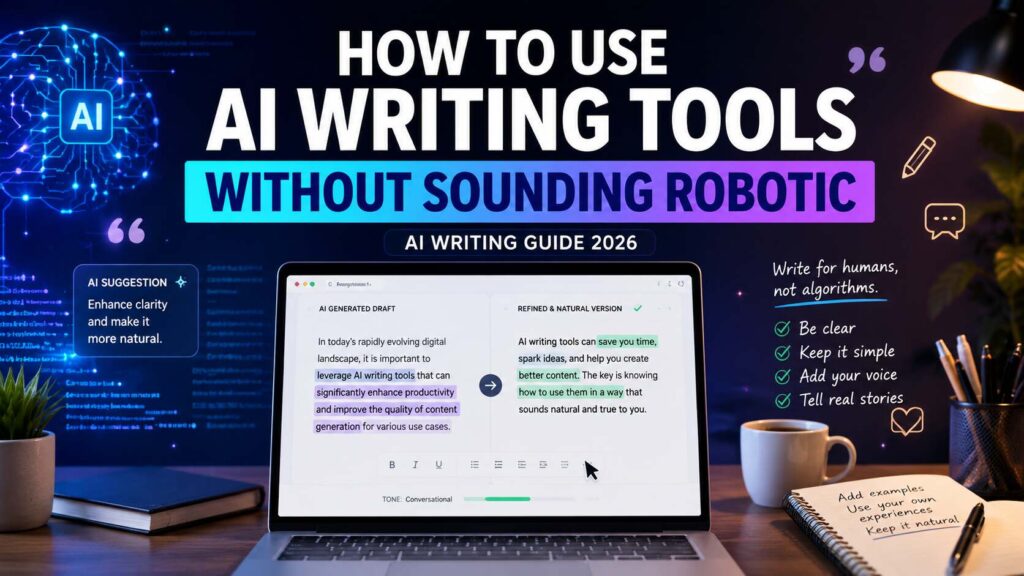
How to Use AI Writing Tools Without Sounding Robotic
In 2026, Siege Media and Wynter report that 97% of content marketers now use AI writers. Meanwhile, across aggregated industry survey data cited by Firewire Digital, more than 70% of readers report they’re “less” likely to engage with content they perceive was “fully written by AI.”
How can both be true?
They can, and they are.
We’re all relying on these tools to some extent – and a lot of the resulting output looks like it – yet more than half of the marketers that now employ this technology are sending content through humanization software before it ever lands in inboxes (and you can draw what conclusion you’d like there about “how a person,” vs. A robot, wrote a given piece of content. The issue isn’t the tools; it’s the workflow. When you’ve handed off a piece of AI work to “draft the entire thing from start to finish”-effectively the AI ghostwriter-you’re going to produce entirely unremarkable, indistinguishable, non-people press releases that literally no one requested.
When, conversely, you utilize the AI tool as the quick-task collaborator (to handle the speed, not the content strategy), you will actually produce useful stuff.
Here are some specific examples-as in, particular workflow tweaks, a particular edit style, specific prompt patterns that’ll get you producing content that sounds like… well, one or more humans wrote it. (Because, truly, they have).
Why AI Writing Sounds Robotic (and What Actually Causes It)
Before fixing the output, it helps to understand what produces it. Most people blame the tool. The real cause is usually the prompt.
Vague prompts produce vague output
Generic prompts result in generic output. “Write a blog post about antivirus software” will give you the statistical median of all blog posts about antivirus software ever created. The result will be a sound, well-structured explanation that hits the big points and is completely indistinguishable from the 50 other posts to appear when searching for the query. Because AI has no understanding of who you are, what angle you wish to pursue, who your reader i,s or what actually happens to be your thoughts on the subject it guesses – and it will guess what best likely combination of words for that subject means – which in other words is the best way to describe anything and everything, the most likely, common, bland of all.
AI optimises for coherence, not personality
The predictions that AI language models make based on sequences and word probability will provide you with text that follows logic without adding any distinctive voice, opinion, or surprising turn of phrase that might otherwise be expressed by an actual individual. This is either something you include in the prompt or in your subsequent editing.
The patterns readers catch
Every single user of AIs who claims not to be able to explain what is ‘AI-generated’ in any given text will pick it out. Every other sentence in the text can comprise between 18 and 25 words, and all the transition sentences are signalling a structure rather than original thought,t like ‘furthermore’, ‘in conclusion’. The AI will always hedge when presenting a point of argument, never commit, and there will likely be a few lists of 3 to 5 bullet points, whereas an individual would simply pick the 1 most relevant and flesh it out.
The copy-paste problem
Most people, as a direct effect of their time being valuable, simply grab the output and post it. Whether one quickly reviews the copy and fixes the occasional error, there was never an editor who gave their input; a human who inserted an anecdote. When AI gives us a skeleton, we are also presented with very little body for us to then attach.
The Right Way to Think About AI Writing Tools
Useful framework: you supply the thinking, opinion, specific details, and voice. AI supplies the structure and the speed. This division is what the data supports. ‘In a2026 report from Siege Media and Wynter,’ writes the latter’s CMO Jon Fisher, ‘only 1 percent of content marketers claim 100 percent of their content is created by AI.’
The remaining 99 percent are using the tool as just one step in the process.
‘In their 2026 study, HubSpot found that content marketers that utilize AI currently save, on average, 6.1 hours a week,’ it says, and ’that savings were driven not from AI eliminating human thought, but from sped-up first-drafting and revisions.’ The practical split looks thus: use AI for outlining, first drafts, untangling sentence heads, creating headlines, and summarising information you’ve found. Keep the opinion, any conclusions you have, any specific examples, and anything you say that’s advice drawn on your own experience for yourself. Only you can have tested the software, decided it was the most annoying expense in your calendar year, and read the audit to determine whether a user is losing data.
Put this in.
7 Techniques That Produce Human-Sounding AI Content
1. Write a detailed brief before prompting
I will be able to add to every prompt: ‘banned words and phrases: Don’t use furthermore, it is interesting to note, to conclude, utilizing, slick, cutting-edge, stable, newfangled, modern society’. I’m going to pop in a sentence or two that I’ve already produced, maybe with some stat that I have corroborated and can back up, a real stance on the matter, or even an instance of where it happened to me personally. The quality of the text I get back is almost entirely the quality of the text I feed in. A prompt where I specify audience, my core message, the tone I’m looking for, 2-3 things to include, and 2-3 things to exclude will give me a draft that needs one editing round. A prompt like “write a blog post about X” will produce a draft I need to rebuild from scratch.
Before I even open the AI tool, I will draft out the brief in plain English.
Who is my audience?
How should they feel, think, or behave after reading this?
What is the one thing I want to say that other similar articles are not saying?
I can then copy and paste this brief into the AI tool as my prompt.
2. Give the AI your own material to work from
The surest way to avoid generic output from an AI is to give it specific material to work with. I will paste a sentence or paragraph I’ve already written into the prompt, perhaps with a statistic that I’ve checked and verified, or with a position I actually hold on the topic, or even with a specific scenario that I experienced.
The AI will build around my material rather than with me inventing placeholders for it. In my experience, one actual piece of data supplied is worth five paragraphs of filler constructions “for example…”
3. Specify the sentence rhythm explicitly
By default, AI outputs have uniform sentence length: most will come out between 18 and 25 words. That makes them readable but monotonous. They don’t have the variation, or emphasis, or breath needed for interesting and engaging text.
I can specifically ask for this: “Vary the sentence length in your output. Use short sentences; then one longer sentence adding explanation or reasoning; then back to short sentences. Do not use consecutive sentences of the same length.”
4. Name the banned words and phrases
The surest way to avoid generic output from an AI is to give it specific material to work with. I will paste a sentence or paragraph I’ve already written into the prompt, perhaps with a statistic that I’ve checked and verified, or with a position I actually hold on the topic, or even with a specific scenario that I experienced.
5. Ask for a rough draft, not a finished piece
The way I ask the AI for output can and will influence the result. If I ask it to write “a finished, publish-ready blog post,” it feels compelled to produce output that looks finished, which sometimes means it is actually wrong but lacks the kind of obvious flaws that can be easily corrected. If I ask it to “write a rough first draft, for further editing,” it provides material which is often more open and honest about its gaps – precisely what I want from my first editing round.
I will therefore frame the request properly: I am not asking the AI to write something for me to publish as-is; I’m asking it to create material which I can then work with and build upon.
6. Edit out loud
When I first get my draft from the AI, before anything else, I will read it out loud. Any sentence that I stumble over, or pause awkwardly on, or that just sounds unnatural, and my mouth objects to saying, will be a sign that it needs rewriting. The human eye is often too lazy to spot patterns in AI output; the human mouth has to perform them, and instantly detects when something is amiss.
7. Add one thing the AI cannot know
No matter how well I prompt the AI, every piece of AI-generated text will be missing something, and it’s that ‘something’ that is uniquely mine. Maybe it is a particular, verified statistic from a primary source, a specific example from a product or piece of technology that I’ve personally used or tested, a nuance of my opinion that differs from the mainstream, or even a tiny detail that I only noticed because I was actually present or participating. One of those things will be included in my final post.
That final contribution from me is what separates AI output that anyone could have written from writing that actually came from me.
A Prompt Template That Actually Works
Copy this structure and fill in the brackets before every AI writing session.
You are an experienced [niche] writer. Your audience is [specific reader description].

Task: Write a rough first draft of [specific piece — headline, blog post, product description] covering [specific topic].

The one thing I want the reader to take away: [your actual point].

Include these specific elements: [2–3 things — a statistic, an example, a particular angle].

Tone: [direct / conversational / formal]. Active voice. Varied sentence lengths — short, then long, then short.

Do not use: furthermore, it is important to note, in conclusion, leverage, seamless, cutting-edge, robust, innovative, in today's world, or any phrase that reads like a transition rather than a thought.

This is a first draft I will edit. Prioritise substance over polish.
The difference between this and “write a blog post about X” is the difference between giving a brief to a capable writer and asking a stranger to guess what you need. The AI is capable. The brief is your job.
The Editing Pass That Removes AI Patterns
So, how do most people edit AI content? Usually, they read through it and fix what they see, the same as anything else they’ve written. Unfortunately, that’s not sufficient. AI content generates certain, predictable problems, and editing it requires specific, systematic editing passes.
Pass 1 – Structure. Does every paragraph fulfill a need? Read the first and last sentence of each. If these two statements are the same, there is excessive filler-cut it.
Pass 2 – Sentence rhythm. Words should neither drone on interminably nor skip like pebbles on a lake. Count out five contiguous sentences in your draft and estimate sentence length. If all of these are within 15-25 words, it is a flat, monotonous structure; break up the longer sentences and connect the weaker, short sentences to the previous ones.
Pass 3 – banned phrases. Search your word processor for every instance of “however,” “furthermore,” “it is important,” “in today’s world,” “leverage,” “seamless,” “state-of-the-art”, etc. Delete each of these and/or replace them. With this pass, most drafts lose their most prominent, robotic tone.
Pass 4 – Voice. Read aloud from beginning to end. Highlight and rephrase the sentences you naturally feel the urge to skip. The natural rendering you just created will be far superior.
Pass 5 – Specificity. Highlight any subjective or general statement within the draft.
“Most businesses utilize this concept.”
“Researchers have found that.”
“Specialists concur.”
Add quantitative data-the numbers of some companies or organizations-named experts, or a specific source to each highlighted sentence, or use a tangible example; vague assertions are an ideal cover for filler text.
Grammarly’s editing layer corrects grammar, readability level, and sentence structure in the drafts that AI generates, and it is an appropriate extra step after you complete the passes mentioned above to catch any remaining omissions.
What AI Writing Tools Are Actually Good At (and What They Are Not)
It’s worth being honest about this because most guides overstate the capabilities of tools and most critics understate them.
The AI tools are good at:
Outlining from a simple prompt; writing first-draft text rapidly; rewriting an awkward sentence; giving hundreds of different suggestions for headlines very fast; mass-producing product descriptions; and summarising research you’ve done at source. Used for these purposes, they save real time. According to HubSpot’s 2026 data, it saves the average marketing professional 6.1 hours every week.
They are bad at:
Providing a genuine opinion; correctly citing an information source without making it up; writing about recent events that happened after their training data was finalised; and mimicking the specific tone of voice required without lengthy examples to refer to. If you ask an AI to recommend a piece of software, it will generate a list of relevant items that appears plausible but which could be completely factually incorrect. There is no way of verifying what it writes actually works, or even still exists, let alone that it is currently the cheapest possible source.
Google does not penalize AI content:
According to John Mueller and repeated throughout 2026, the company only penalizes low-quality content. Its systems are simply looking for a useful piece of information backed up by expertise, and don’t care whether you are human or AI-generated content. According to Ahrefs’ 2026 analysis of 900,000 new web pages, over 3/4 (74.2%) contained AI-generated content, but the ones ranking at the top have something in common that the ones lower down don’t. Real information and an original point of view.
That point of view needs to come from you.
Frequently Asked Questions
Does Google penalise AI-written content?
No. Google looks at content quality, not content creation source. Google’s systems don’t automatically penalise AI-written articles, and John Mueller, Google’s SEO Advocate, corroborated this in a 2026 interview.
They penalise poor-quality content – “thin” or factually incorrect- not poor-quality content made by AI.
Basically, if AI-generated content is demonstrably expert and helpful, Google does not penalise it. If it’s poor, lacking any of the factors that make content valuable to users, whether human-written or not, Google will.
How can you tell if content was written by AI?
Uniform sentence length; excessive transition phrases (e.g., “moreover,” “furthermore,” “it should be noted”), hyperbole, listicles that make one basic argument in multiple ways, and excessive hedging without concluding with a definitive stance are most telling. AI output is prone to reiteration. You know the language by how repetitive the article’s subject and style feel throughout. There are no AIs on the market precise enough to accurately judge individual pieces of content as written by the tool or human author, but many consistent similarities have been noted between published works.
What is the best AI writing tool for bloggers in 2026?
• For writing the bulk of an article and assistance during the editing and proofreading process – Grammarly Pro; • Long-form content creation for your blog- Jasper AI. • For more granular, creative, custom prompts- ChatGPT. In terms of overall utility, there’s a definite learning curve.
Please keep in mind that this post review is a comparison of the many tools so that you can make the best choice.
• Grammarly’s review. • Jasper AI’s review.
•Should I consider AI for the entire writing of my article?
Can I use AI to write my whole blog post?
Based on our report last year, it should be the considered judgment of 100% of content writers to utilize tools for parts of the writing process; most content writers-approximately 99% of content marketers and content creators from our survey-do not make use of this new generation of AI to write whole blog articles. This is largely because while a post is readable and technically sound, the quality the tool lacks is the distinctive human quality that all great content possesses – and more: opinion and personality; true, firsthand insights; real-world examples from your personal experience; a personal touch; a true personal voice….A whole article created on the tools would surely be coherent but not very remarkable….A wholeAI-createdd post, lacking the points mentioned, isn’t the way most bloggers want to drive their audiences to their writing.
How do I make AI writing sound more natural?
• Give specific directions: when interacting with the software, present not just the subject but also how it should address the issue, from your particular POV. Also, share what should and what you will not stand for as your guidelines in every communication, as they get processed and the material is then written in that regard; hence the banned words as well as the instructions for what not to have in that article are of immense help; • Avoid general instructions; be explicit!
• “Write the first draft” and let the reader correct whatever they need, even read it out loud, and rewrite what feel the not-quite-ready-and add at least one fact, number, specific detail,l as I already mentioned, ed that will ensure that I add in “my flavor”. With a consistent approach to these principles-even a rudimentary knowledge of the material in addition to the AI’s- I’m able to produce written materials that sound to the reader nearly exactly as if I had spent all day long on the material.
What AI writing patterns does Google look for?
The Google search algorithms will undoubtedly look at a series of signals to identify AI-based content from written content. However, as there are no “official indicators” listed by Google, Google uses its system and evaluates the helpful, informative, expert, and authoritative elements within that context; from here, it judges if it qualifies as useful or not on the topic where it’s written on….A writer creates the article based on their original expertise, as they put in their experience and opinion, whereas AI-written content lacks true authority. So you should try to add human qualities.
Wrapping Up
AI is a speed tool-not a voice tool. The speed is there (6.1 saved hours/week is nothing to sneeze at). The voice is and can only ever be yours, and you can’t outsource it without losing why the content is worth reading.
So what’s the workflow that does work? Provide the AI with a tight creative brief-including you actual point, specific content to pull from, etc.-let it produce a raw draft, punch it through the five-pass edit outlined above, include whatever unique thing only you could include, and publish. It takes longer than generating and publishing, but it’s worth reading.
If you need help with the edit pass, Grammarly picks up the passive language, excessive sentence construction, and lack of readability that tends to creep into AI-powered text.
Related reading: